There’s Still Time to Order Echinacea for the Fall
If you haven’t ordered your Echinacea for Fall there’s still time and availability to order for a June ship date.
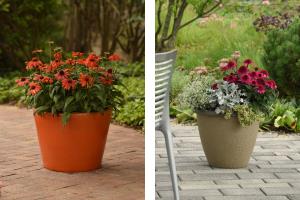
Photo (left): Container featuring Sombrero Mandarin Mambo Echinacea. Photo (right): Mixed Perennial Container featuring Double Scoop Watermelon Deluxe Echinacea, What A Doozie Sedum, Loreen Compact White Euphorbia, and Silver Swirl Centaurea.
Echinacea for Fall
Find varieties that best fit your Fall program with Echinacea Sombrero® in more than 10 vibrant colors. With its exceptional Winter hardiness and excellent landscape performance, it’s a highly floriferous series that stays compact for easy shipping.
Plant Sombrero in late Spring and have it ready for Fall sales. Tips for a winning crop and generate interest this Fall:
- Sombrero doesn’t need a cold treatment to flower, and unlike other echinacea, it bulks up well under long days. Combine this with their lengthy bloom time (even well past first frost), and they’re easy to schedule for Fall color without concern for them fading out.
- When purchasing liners, check with your supplier about any PGRs they may have applied to the crop. An application of Configure in the liner stage can be beneficial for branching. However, if applied within two weeks of transplanting, it can affect the speed of rooting out into the container.
- Transplant Sombrero liners one plant per pot into 2.5-qt or 1-gal. pots, or three ppp for 2- to 3-gal. containers (Maybe a deco pot? Maybe three different colors for a mix?). Media should be well drained with a pH of 5.8 to 6.2. (I don’t like the pH dropping below 5.7.) Controlled-release fertilizer incorporated into the media is common; I would recommend a medium to higher rate. Top-dressing is also okay, but avoid application too close to the transplanted plug.
- These can finish relatively quickly: eight to 10 weeks for August flowering and 10 to 12 weeks for sales into October. For multi-plant containers, I would add another two weeks. With Sombrero having such a long bloom time, I like to be cautious and go with the longer scheduling.
- Southern growers should not plant after week 25, while Northern growers have until week 29. This is all due to daylength changes.
- Echinacea are long-day obligate for flowering and there may be some premature budding. Look carefully for buds and remove these at transplant and during the first two weeks after (ideally). This will speed up the lateral branching and bulking.
- Once established, monitor the crop's nutrition; echinacea are relatively heavy feeders. This is why I like controlled-release fertilizer in the Summer. However, this often needs to be supplemented with liquid feed. If applying liquid feed, use a well-balanced formulation at 150 to 200 ppm N. Under high light and temperatures, a formulation with some ammoniacal nitrogen such as 20-10-20 will provide a deeper green color than a more nitrate-based fertilizer.
- Likewise, under high light, higher amounts of phosphorous are needed. Be aware of purpling on the lower leaves — this is an indication of deficiency and additional phosphorous should be applied, even if using controlled-release fertilizers. Again, the use of 20-10-20 is very beneficial to Echinacea in the Summer.
Also, don’t forget our First-Year Flowering Tool to help you schedule your Echinacea and other Fall perennial crops.